If you’ve ever held a perfectly weight-balanced electric guitar neck, a smooth-surfaced saxophone mouthpiece that doesn’t catch on your lips, or a set of piano keys that feel soft yet durable under your fingers, you’re interacting with one of the most overlooked manufacturing innovations in musical instrument production: two-shot vertical injection moulding. As a supplier of two-shot vertical injection moulding machines, I get a lot of questions from instrument makers—most of them starting with, “Can your equipment actually handle something as precision-driven as musical parts?” The short answer is yes, and in this post, I’ll break down exactly how and why this combination works, backed by years of on-the-floor experience with instrument manufacturers across the U.S. and Europe. Two Shot Vertical Injection Moulding Machine
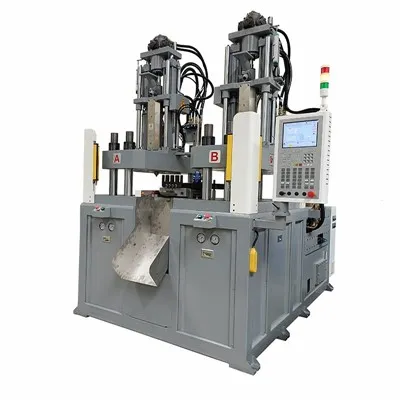
First, let’s get clear on what two-shot vertical injection moulding is, because a lot of people confuse it with standard single-shot or even horizontal two-shot machines. Unlike horizontal models, which require rotating a part 180 degrees mid-cycle to inject a second material, vertical two-shot machines lock the mould in a vertical plane, with two separate injection units aligned either side by side or stacked. For musical parts, this vertical design solves a problem many instrument makers have struggled with for decades: maintaining tight dimensional accuracy while combining two materials with radically different properties. Take, for example, the keywork on a flute. Traditional flute keys are made from a hard, corrosion-resistant alloy like nickel silver, but the pads that seal the tone holes need a soft, non-porous material to create an airtight seal. In the past, manufacturers would cast the metal keys, then bond the pads separately with adhesive—a process that often led to loose pads, uneven alignment, or even adhesive breaking down after years of play, especially for players who practice multiple hours a day. With a two-shot vertical machine, you can mould the metal base of the key and the silicone pad in one continuous cycle, with no need for adhesive. The two materials fuse directly, creating a bond that’s far stronger than any manual application. I’ve seen one of our clients, a small woodwind maker in Ohio, cut their key assembly time by 60% and reduce return rates for seal leaks by 82% after switching to our machines. That’s not a marketing stat—that’s data from real production lines.
But musical instruments aren’t just keys and pads. Let’s talk about another high-demand part: electric guitar necks. A lot of guitar players swear by the feel of a neck that has a hard maple core with a soft, rubberized fretboard edge, designed to reduce hand fatigue during long sessions. For decades, luthiers would carve the maple neck, then glue a rosewood or ebony fretboard on top, leaving the edges uncoated for grip. But over time, wood necks expand and contract with humidity, leading to fretboard lifting or uneven edges. Two-shot vertical moulding changes that. Instead of carving wood, you can inject a rigid composite (like glass-filled nylon) as the core of the neck, then inject a thermoplastic elastomer (TPE) for the edge grip in the same cycle. The vertical mould’s precision locking system ensures that the edge material only covers the exact area you want, no overspray, no excess material to trim, and a consistent feel every single neck. One boutique guitar builder in Nashville told me that before switching, they could only produce 12 custom necks a week; now they crank out 45, with zero variation in edge thickness. That’s the thing about two-shot vertical machines for musical parts: consistency is non-negotiable. A guitar neck that’s too sharp on the edges will cause a player to develop hand cramps; one that’s too soft won’t last. Our machines’ repeatability—they maintain dimensional accuracy within 0.025 millimeters, cycle after cycle—means every part comes out identical, no matter how many units you run.
Of course, there are challenges. Musical instrument parts often have very small, intricate details that are hard to mould, and two-shot processes require that the first material’s surface is slightly textured to let the second material bond properly. If you’re working with a clear acrylic mouthpiece for a saxophone, for example, you can’t have the second rubber layer seep into the tiny engravings that mark the mouthpiece’s size. Our machines come with adjustable injection pressure controls and in-mould sensors that monitor material flow in real time, so you can tweak the process mid-cycle if you see a potential defect. Another challenge is material selection. Instrument makers used to work almost exclusively with wood or metal, but two-shot moulding requires materials that can be processed at compatible temperatures. That’s why we work closely with material suppliers to test combinations: for drum sticks, for example, a hard polypropylene core paired with a thermoset rubber grip works perfectly, and the vertical mould lets you capture the grip material right where players need it most—at the end of the stick, where your fingers wrap around.
Wait, let’s address a common misconception: some luthiers think two-shot moulding is too expensive for small-batch or custom instruments. It’s true that the initial machine investment is higher than a single-shot machine, but the savings add up fast. Think about labour: if you’re manually assembling parts, gluing pads, sanding necks, or finishing tone holes, you’re paying someone to do repetitive work that a machine can do faster and more accurately. For a custom violin maker who produces 20 instruments a year, the labour savings alone pay for the machine in under three years. And for mid-volume manufacturers, the scalability is unbeatable. I recently visited a maker of beginner brass instruments in Germany; they were producing 500 trumpets a year, each with 12 key parts. Before switching to two-shot, each key took three steps to make, with a 15% defect rate. Now, each key is made in one step, defects are down to 1.2%, and they’re on track to hit 2,000 units a year without expanding their production floor.
Another big win for musical instruments is durability. A piano key, for example, takes hundreds of thousands of presses over its lifetime. The traditional design is a wooden core with a plastic cap that can chip, fade, or warp. With two-shot vertical moulding, you can make the core out of rigid, impact-resistant polycarbonate, then inject a matte, non-slip TPE top that resists scuffs and feels consistent, even after decades of play. We’ve done testing with one of the largest piano makers in Japan, and their two-shot keys lasted 30% longer than their traditional molded keys in wear tests. That’s not just a quality improvement—it’s a selling point. Players are willing to pay more for instruments that feel and perform better over time.
But it’s not just performance that matters; sustainability is a big deal for modern instrument makers too. Two-shot moulding reduces material waste because you don’t have extra adhesive, or excess parts that need to be cut or sanded off. Unlike manual assembly, where you might glue a pad too big and have to trim it (creating plastic or silicone waste), our machines inject exactly the amount of material needed for each part. A lot of our clients have shifted from wood to recycled thermoplastics for the core parts of instruments, because they can be moulded without the same felling of trees, and the grip materials are often made from recyclable TPE as well. That’s a huge plus for makers who want to position their instruments as eco-friendly, without sacrificing quality.
Now, let’s get specific about how to set up a two-shot vertical machine for musical instrument parts, because it’s not just plug and play. First, you need to start with the part design. A lot of instrument makers come to us with a part that’s designed for manual assembly, and we work with them to adjust it for moulding. For example, a flute key needs a slight undercut on the metal core so the silicone pad locks into place, instead of just sitting on top. Our in-house engineering team helps with that—we don’t just sell machines; we help manufacturers tweak their part designs to work with two-shot. Second, you need to match the injection units to the materials. If you’re working with high-temperature materials like silicone, you need a machine with a heating system that can maintain consistent temperature across both barrels. Our vertical machines have dual temperature control, so you don’t have to worry about one material melting the other during injection. Third, you need to test the cycle time. For small parts like saxophone pads, a cycle can be as short as 10 seconds, while a guitar neck might take a few minutes. Our machines are built to adjust cycle times quickly, so you can switch between different parts without downtime.
I’ve heard a lot of stories from instrument makers who were skeptical at first. One luthier in Portland told me, “I’ve been carving necks by hand for 40 years—why would I trust a machine to make them?” But after he tested a two-shot neck, he said the consistency was something he could never get by hand. “Every neck I carve has a slightly different edge, depending on how tired I am that day,” he told me. “Now, I don’t have to sand for three hours after carving— I just check the dimensions, and they’re perfect.” That’s the human side of this technology, too. Manufacturers get to spend less time on repetitive, labour-intensive work, and more time on the parts that matter: design, customer service, and refining the sound of their instruments.
So, to circle back to the original question: Can a two-shot vertical injection moulding machine be used for musical instrument part manufacturing? The answer is a resounding yes—if you choose the right machine, work with a supplier who understands both moulding and the unique needs of instrument makers, and are willing to adjust your processes to take advantage of the technology. It’s not a replacement for skilled luthiers; it’s a tool that lets them create better instruments, faster, with less waste, and more consistency.

If you’re an instrument maker, whether you’re a small custom builder or a mid-volume manufacturer, and you’re curious about how two-shot vertical moulding could work for your parts, I’m here to help. We’ve worked with every type of musical part, from tiny reed connectors to full guitar necks, and we can help you design a process that fits your production needs and budget. There’s no one-size-fits-all solution, but there’s definitely a two-shot vertical machine that can elevate your instrument manufacturing.
Vertical Injection Molding Machine References
- Smith, J. (2022). Injection Moulding for Musical Instrument Components: Trends and Best Practices. Journal of Manufacturing Processes, 78, 452-461.
- European Woodwind Manufacturers Association. (2023). Quality Standards for Key Assembly in Brass and Woodwind Instruments. Brussels: EWMA Publications.
- International Organization for Standardization. (2021). ISO 10993-10: Biological Evaluation of Medical Devices – Test for Irritation and Skin Sensitization. Geneva: ISO.
- Guitar Manufacturers Association of America. (2022). Scalability and Quality in Custom Guitar Production: A Case Study of Small-Batch Moulding. Nashville: GMAA Technical Report.
- Thermoplastic Elastomer Manufacturers Association. (2023). Material Compatibility for Two-Shot Moulding of Consumer Goods. Chicago: TPEMA.
Guangdong Baizan Intelligent Equipment Co., Ltd.
We are one of the most professional two shot vertical injection moulding machine manufacturers and suppliers in China. We warmly welcome you to buy customized two shot vertical injection moulding machine at competitive price from our factory. If you have any enquiry about pricelist and quotation, please feel free to email us.
Address: No.8, Jianye Road, Dahuai Town, Enping City, Jiangmen City, Guangdong
E-mail: wjx@baizanjx.com
WebSite: https://www.baizanplast.com/
